
From "Why" to "How"-Deming's 14 Points for Today's School Leader

The exponential changes that we are seeing as a result of the Fourth Industrial Revolution are driving rapid change in the world around us. These changes bring more conversation about the relevance of high school education and needed changes that need to be made in our school systems. To successfully lead needed changes, school leaders are faced with any number of short-term and long-term challenges. Many leaders see the need to change and understand the "why" behind the transformations that need to be made. The "how" aspect of taking on and leading change can be more elusive - Deming's 14 Points, adapted for today's school leaders provide a starting point for meeting those challenges"
Profound Knowledge - How to Lead Transformation
Skill and practice in the management and leadership principles of Edwards Deming provide a great starting point for leaders looking to embrace the systems thinking methodologies that will create needed momentum in making needed changes that will focus their schools on developing more relevant and engaging experiences for today's students.
Deming developed his system of Profound Knowledge to equip leaders to understand their organizations deeply and lead them effectively. In their June 2016 Quality Porgress article Always Applicable, Moen and Norman quote Deming as saying:
"My aim is to provide a foundation or system of theory for continual change of practice for management to keep up with the changes that are taking place in this world. Even perhaps guide the changes to come"
The foundation of Deming's system of Profound Knowledge can be found in the famous 14 Points. As outlined by Moen and Norman, these came into focus with Deming's work beginning in the early 1980s and then evolved again as part of Deming's book Out of The Crisis.
The 14 Points - Adapted for School Leaders
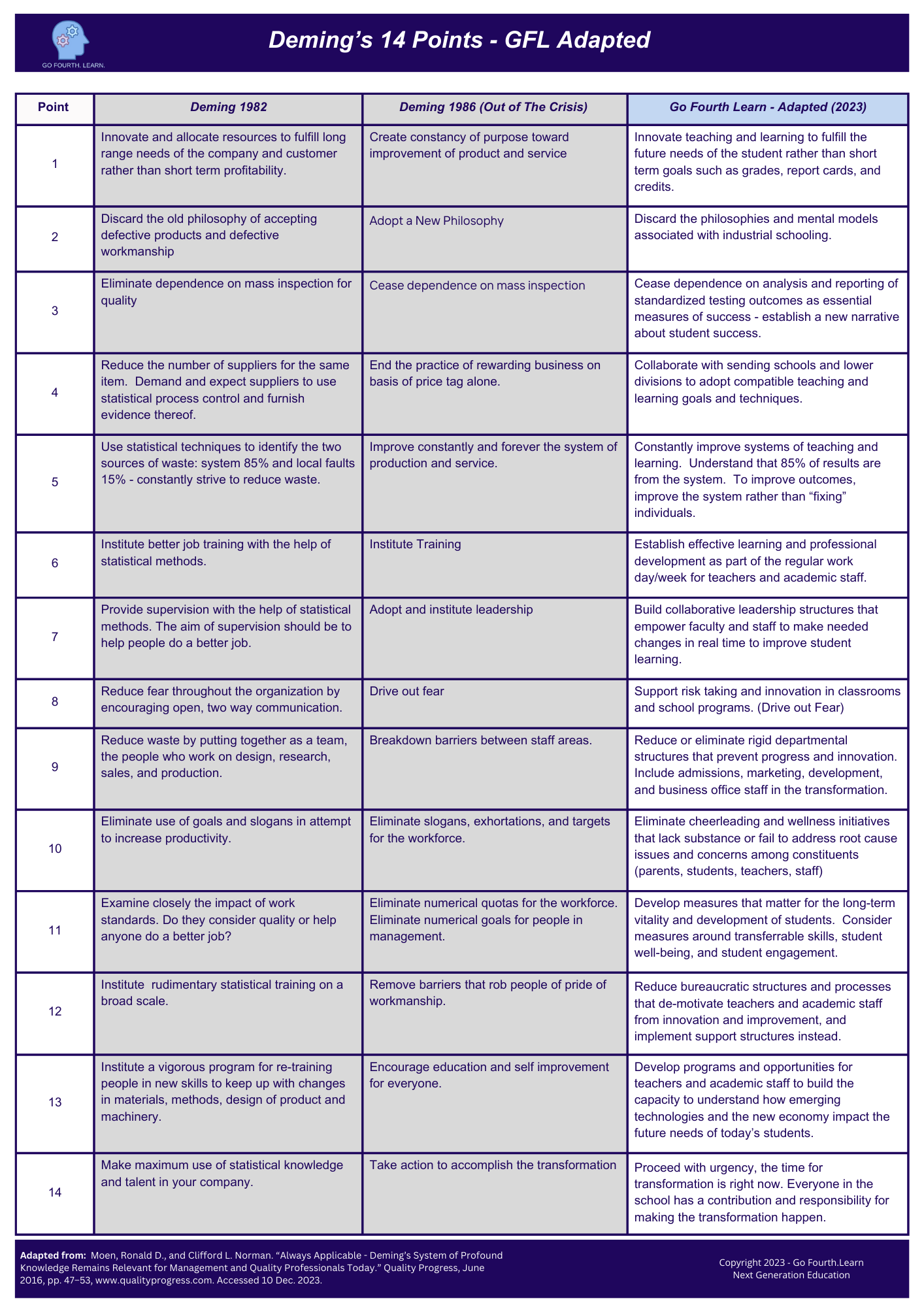
The 14 points in their original form remain relevant. However, some adaptations may be useful for school leaders working in today's educational environments. Consider these updates to the 14 points as a foundation for beginning the work of systems thinking and the application of Profound Knowledge in your school:
Innovate teaching and learning to fulfill the future needs of the student rather than short-term goals such as grades, report cards, and credits.
Discard the philosophies and mental models associated with industrial schooling.
Cease dependence on analysis and reporting of standardized testing outcomes as essential measures of success - establish a new narrative about student success.
Collaborate with sending schools and lower divisions to adopt compatible teaching and learning goals and techniques.
Constantly improve systems of teaching and learning. Understand that 85% of results are from the system. To improve outcomes, improve the system rather than “fixing” individuals.
Establish effective learning and professional development as part of the regular work day/week for teachers and academic staff.
Build collaborative leadership structures that empower faculty and staff to make needed changes in real-time to improve student learning.
Support risk-taking and innovation in classrooms and school programs. (Drive out Fear)
Reduce or eliminate rigid departmental structures that prevent progress and innovation. Include admissions, marketing, development, and business office staff in the transformation.
Eliminate cheerleading and wellness initiatives that lack substance or fail to address root cause issues and concerns among constituents (parents, students, teachers, staff)
Develop measures that matter for the long-term vitality and development of students. Consider measures around transferrable skills, student well-being, and student engagement.
Reduce bureaucratic structures and processes that de-motivate teachers and academic staff from innovation and improvement, and implement support structures instead.
Develop programs and opportunities for teachers and academic staff to build the capacity to understand how emerging technologies and the new economy impact the future needs of today’s students.
Proceed with urgency, the time for transformation is right now. Everyone in the school has a contribution and responsibility for making the transformation happen.
In his book, The New Economics for Industry, Government, and Education, Deming wrote that:
"A system of schools is not merely pupils, teachers, school boards, boards of regents, and parents working separately to achieve their own aims. It should be instead, a system in which these groups work together to achieve the aims that the community has for the school - growth, and development of children and preparation for them to contribute to the prosperity of society. It should be a system in which the pupils from toddlers on up through the university take joy in their learning, free from fear of grades and gold stars, and in which teachers take joy in their work, free from fear of ranking. It should be a system that recognizes differences between pupils and differences between teachers"
Deming wrote this book in 1994, but this quote could have been written yesterday. The concepts around systems thinking and the system of Profound Knowledge hold relevance today. Working from a foundation of the 14 points is a great entry point for those leaders looking to learn more about these ideas as part of getting to the actions that are required of them to make the needed transformations in our schools.
A downloadable file of the GFL Adapted 14 Points, including a crosswalk with Deming's original 14 points can be found in the Tools and Templates section of the GFL Website.
- Dr. Steven Lyng / gofourthlearn.com
References:
Moen, Ronald D., and Clifford L. Norman. “Always Applicable - Deming’s System of Profound Knowledge Remains Relevant for Management and Quality Professionals Today.” Quality Progress, June 2016, pp. 47–53, www.qualityprogress.com. Accessed 10 Dec. 2023.
Deming, W. Edwards. The New Economics for Industry, Government, Education. 3rd ed., Cambridge, Massachusetts MIT Press, 2018.
Deming, W. Edwards. Out of the Crisis. Cambridge, The MIT Press, 2000.